




punchout takes the suck out of logging time on JIRA.
💾 Installation
Pre-built binaries
Download a pre-built binary from the latest release. See Verifying release artifacts for instructions on verifying your download.
Install from source
You can also install from source using the go toolchain:
go install github.com/dhth/punchout@latest
🧭 Tour
New to punchout? Run the interactive tour:
punchout tour
The tour introduces punchout’s worklog workflow, main TUI views and controls, MCP server, and configuration. It does not require a configuration file.
⚡️ Quick start
Create a configuration file if you do not already have one:
mkdir -p ~/.config/punchout
punchout config show-sample > ~/.config/punchout/punchout.toml
Edit the generated file with your JIRA details, then validate it and start the TUI:
punchout config validate
punchout
>_ Commands
| Command | What it does |
|---|---|
punchout | Start the TUI |
punchout tour | Take the interactive tour |
punchout config show-sample | Print a sample configuration |
punchout config validate | Validate the configuration file |
punchout mcp serve | Start the MCP server |
punchout help | Show all commands and flags |
Run punchout <command> --help for details about a particular command.
🔄 Workflow
punchout lets you add worklogs to JIRA in two steps:
- Record one or more worklogs locally.
- Push all unsynced worklogs to JIRA.
You can do this through either the TUI or the MCP server.
⚙️ Configuration
punchout reads configuration from ~/.config/punchout/punchout.toml by
default. Authentication settings differ between JIRA Cloud and on-premise
installations.
# String configuration values can reference environment variables. Referenced
# variables need to be set before running punchout.

# Optional. Defaults to punchout's standard database path.
# db_path = "$SOME_ENV_VAR/punchout.db"

[jira]
# Optional. Defaults to "onpremise". Allowed values: "onpremise", "cloud".
installation_type = "onpremise"

jira_url = "https://jira.company.com"
jira_token = "$PUNCHOUT_JIRA_TOKEN"

# For cloud installations, set installation_type to "cloud", use an API token,
# and provide a username.
# jira_username = "example@example.com"

# Put whatever JQL you want to use to query issues.
jql = "assignee = currentUser() AND updatedDate >= -14d ORDER BY updatedDate DESC"

# Optional. Time difference, in minutes, between your timezone and the JIRA
# server's timezone. Defaults to 0.
# jira_time_delta_mins = 300

# Optional. Used for worklogs when you do not provide a comment.
# fallback_comment = "work"

[tui]
# Optional. Defaults to false.
# use_cache_on_startup = true

# Optional. Defaults to "gruvbox-dark-hard".
# theme = "tokyonight"

[mcp]
# Optional. Defaults to "stdio". Allowed values: "stdio", "http".
# transport = "http"

# Optional. Used when transport is "http". Defaults to 18899.
# http_port = 9999
Command-line flags override values from the configuration file. Use a different
file with --config-file-path, or inspect the resolved configuration with
--list-config; JIRA tokens are redacted from that output.
Successful JIRA issue fetches are saved to a local cache. Set
use_cache_on_startup to true to start with the most recently cached issues
instead of immediately querying JIRA. Press <ctrl+r> from the issues list to
fetch the latest issues and update the cache. If the cache is unavailable,
punchout falls back to querying JIRA.
🖥️ TUI
punchout’s TUI lets you log time against JIRA issues and sync worklogs to
JIRA. You can track time as you work or add worklogs manually.
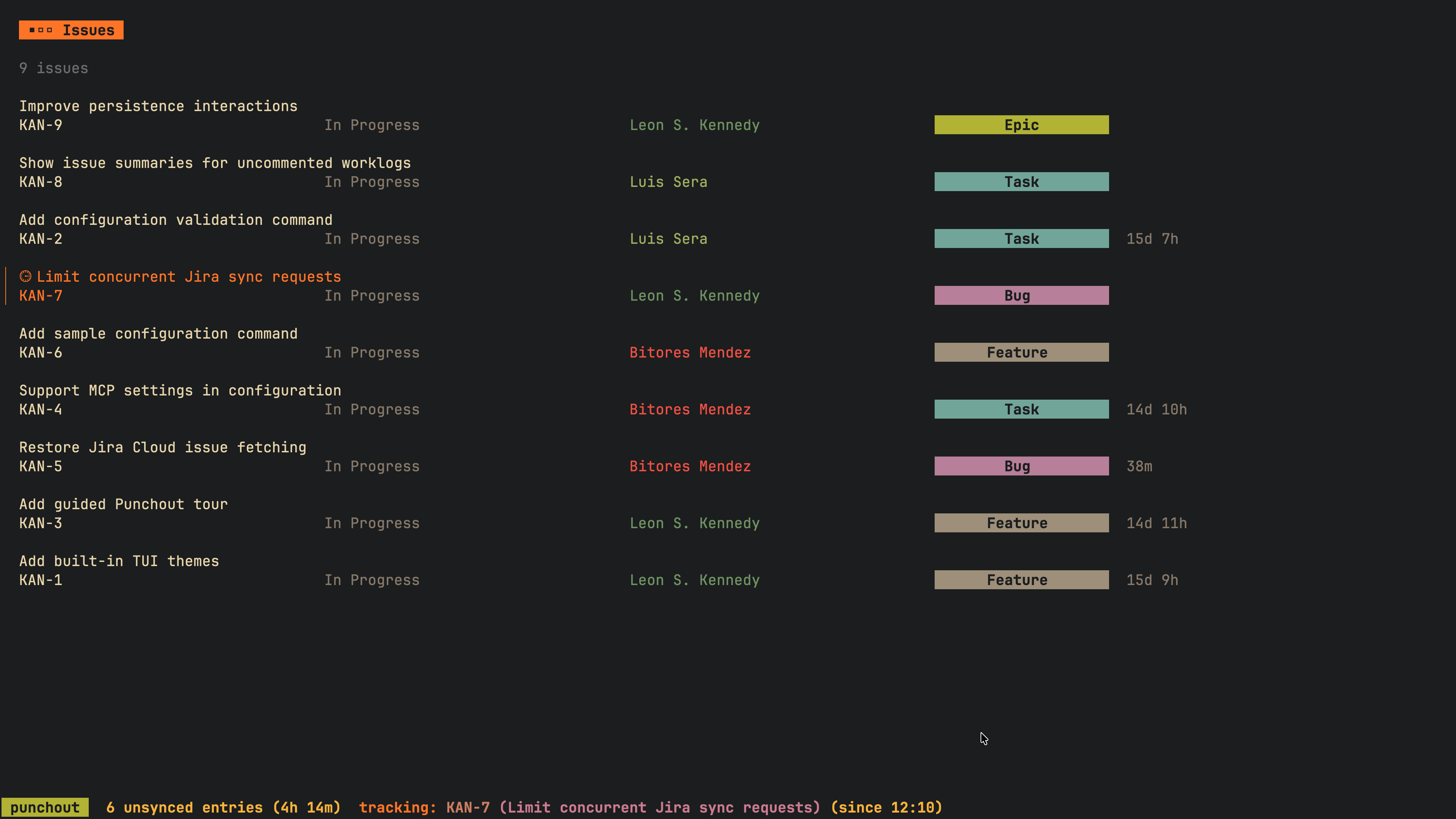
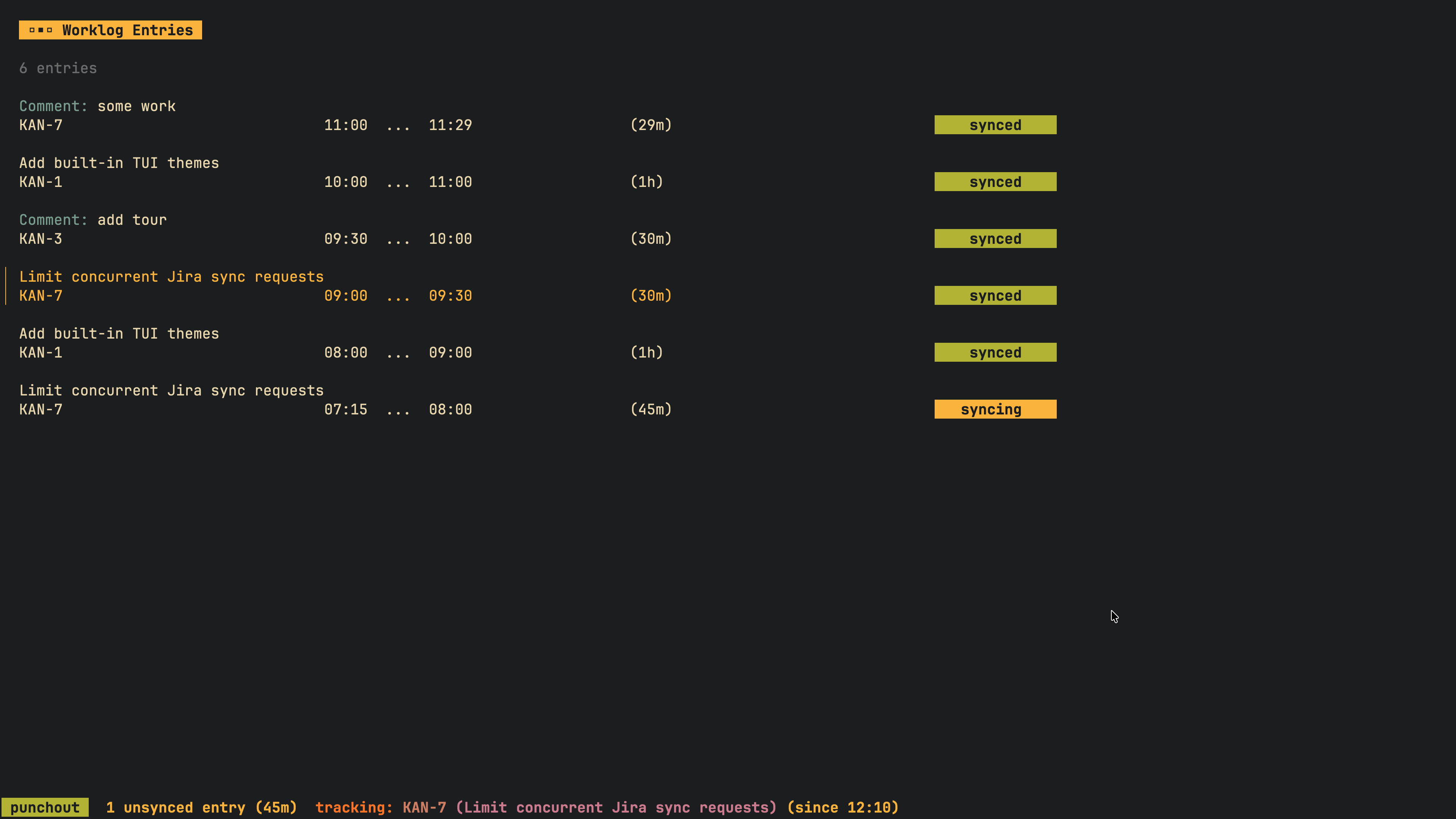
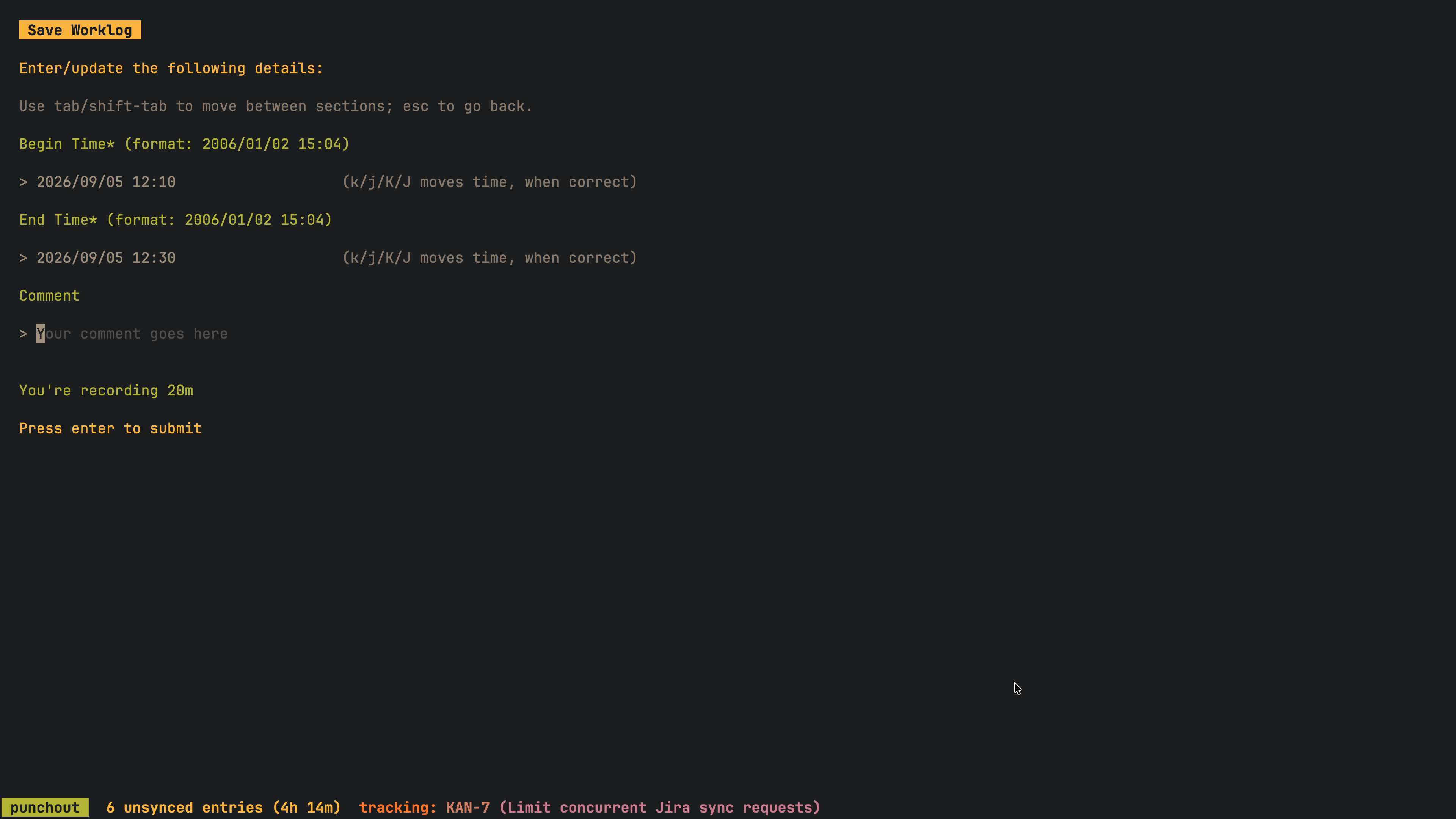
The TUI has 5 primary views:
- Issues List View — Shows you issues matching your JQL query
- Worklog List View — Shows you your worklog entries; you sync these entries to JIRA from here
- Worklog Entry/Update View — You enter/update a worklog entry from here
- Synced Worklog List View — You view the worklog entries synced to JIRA here
- Help View — Shows available keymaps (as listed below)
Keyboard Shortcuts
General
| Mapping | Description |
|---|---|
1 | Switch to Issues List View |
2 | Switch to Worklog List View |
3 | Switch to Synced Worklog List View |
<tab> | Go to next view/form entry |
<shift+tab> | Go to previous view/form entry |
q/<ctrl+c> | Go back/reset filtering/quit |
<esc> | Cancel form/quit |
[ | Switch to previous theme |
] | Switch to next theme |
? | Show help view |
General List Controls
| Mapping | Description |
|---|---|
k/<Up> | Move cursor up |
j/<Down> | Move cursor down |
h/<Left> | Go to previous page |
l/<Right> | Go to next page |
/ | Start filtering |
Issue List View
| Mapping | Description |
|---|---|
s | Toggle recording time on the currently selected issue; opens a form to record a comment on the second s keypress |
S | Quick switch recording; saves a worklog entry without a comment for the currently active issue and starts recording time for another issue |
f | Quick finish the currently active worklog |
<ctrl+s> | Update active worklog entry (when tracking active), or add manual worklog entry (when not tracking) |
<ctrl+t> | Go to currently tracked item |
<ctrl+x> | Discard currently active recording |
<ctrl+b> | Open issue in browser |
<ctrl+r> | Fetch the latest issues from JIRA |
Worklog List View
| Mapping | Description |
|---|---|
<ctrl+s>/u | Update worklog entry |
<ctrl+d> | Delete worklog entry |
s | Sync all visible entries to JIRA |
<ctrl+r> | Refresh list |
Worklog Entry/Update View
| Mapping | Description |
|---|---|
enter | Save worklog entry |
k | Move timestamp backwards by one minute |
j | Move timestamp forwards by one minute |
K | Move timestamp backwards by five minutes |
J | Move timestamp forwards by five minutes |
h | Move timestamp backwards by a day |
l | Move timestamp forwards by a day |
ctrl+s | Sync timestamp under cursor with the other (when applicable) |
Synced Worklog List View
| Mapping | Description |
|---|---|
<ctrl+r> | Refresh list |
Themes
punchout’s TUI comes with several built-in themes. You can see them in action
by pressing [ or ]. Here is a sampling of 4 built-in themes.
| Theme | Preview |
|---|---|
catppuccin-mocha | 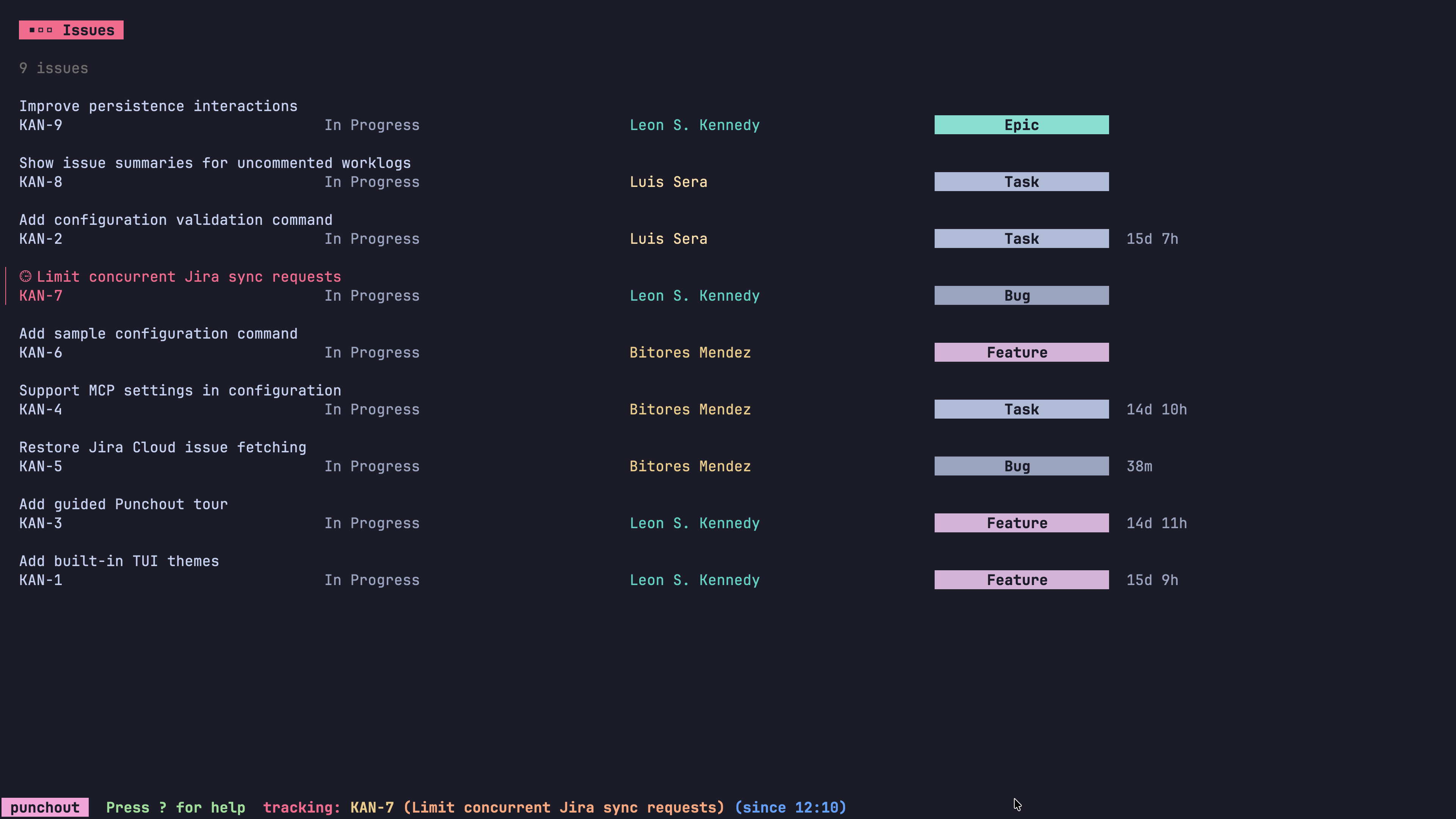 |
monokai-classic | 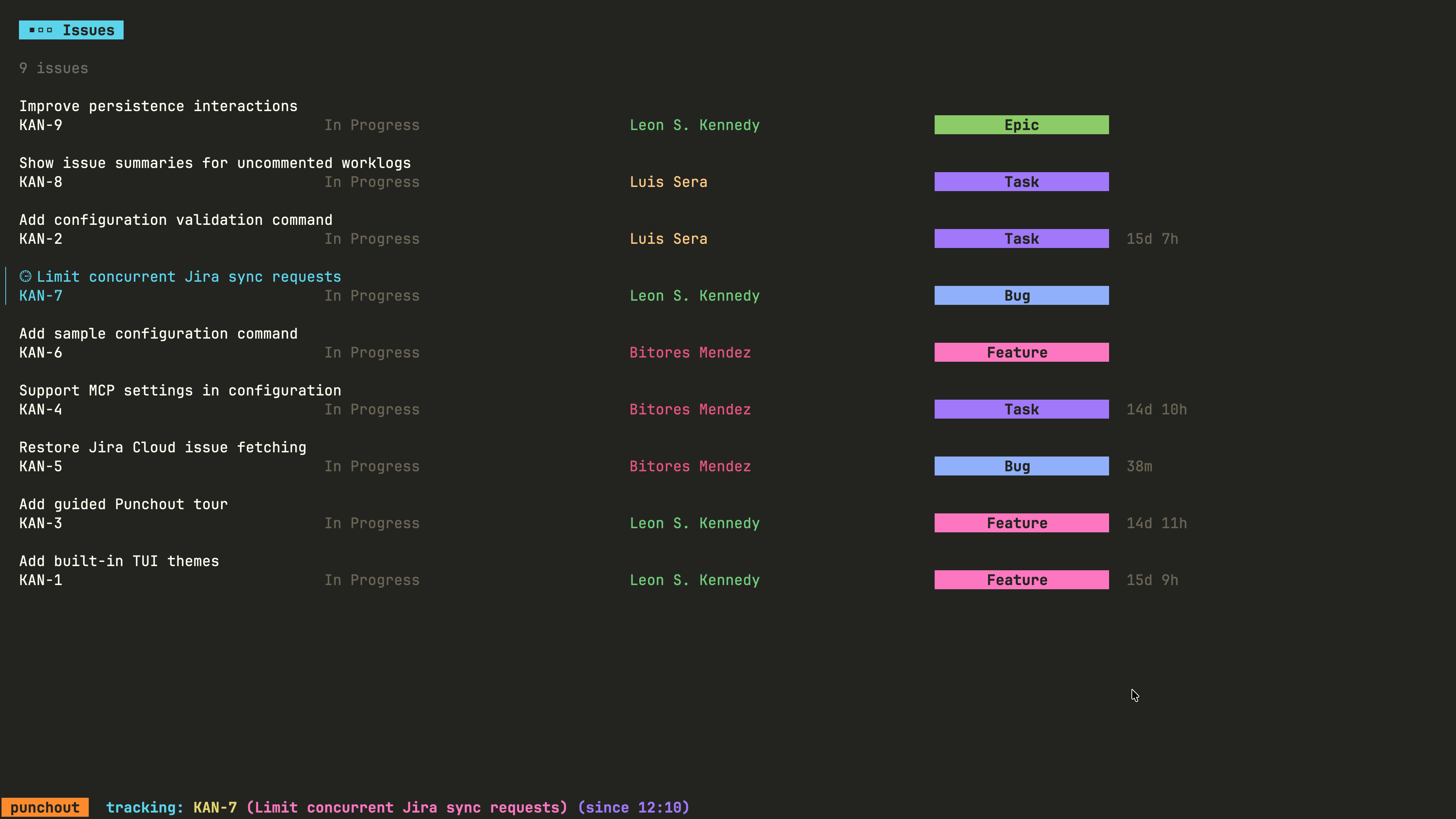 |
rose-pine-moon | 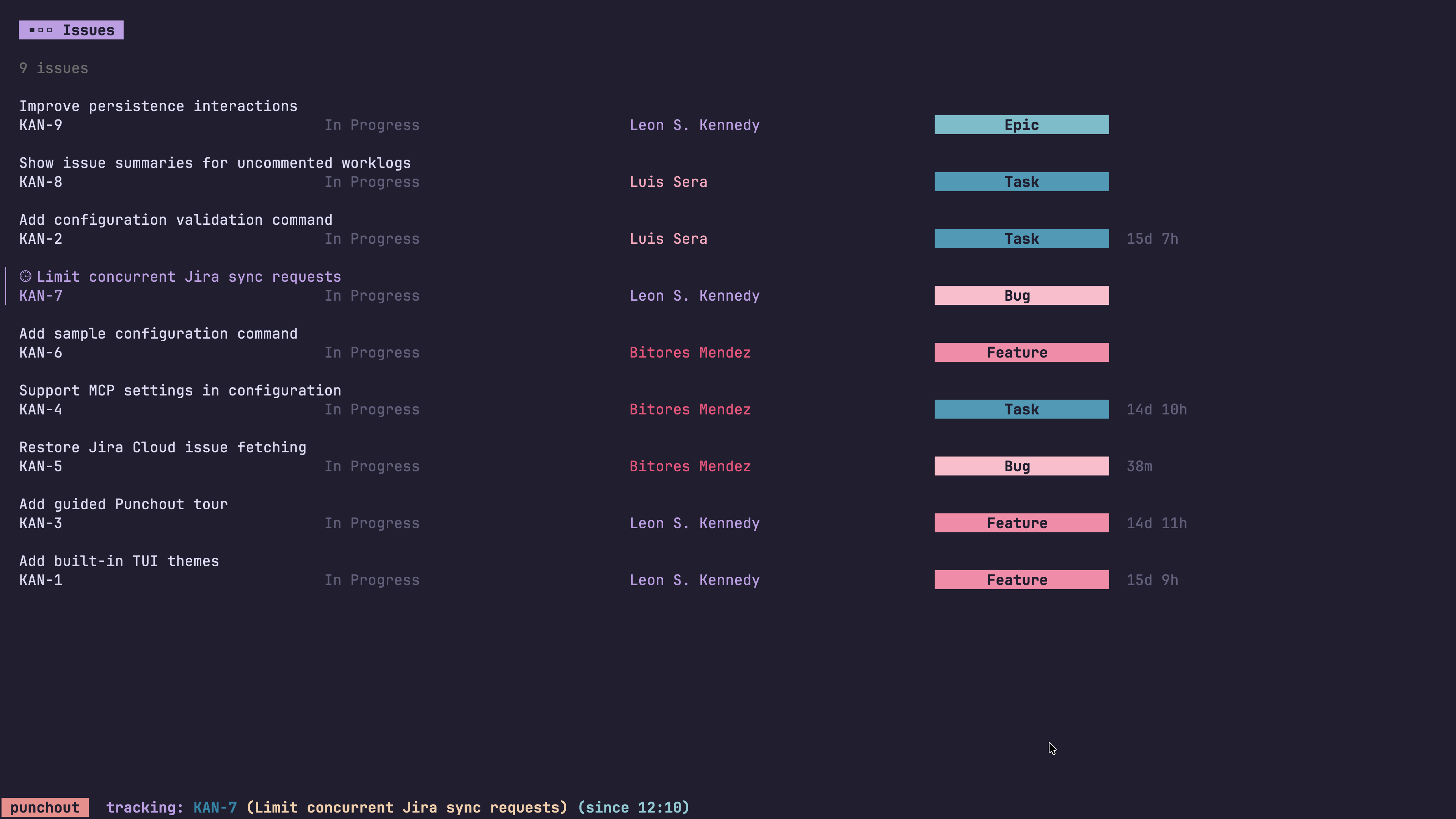 |
gruvbox-light | 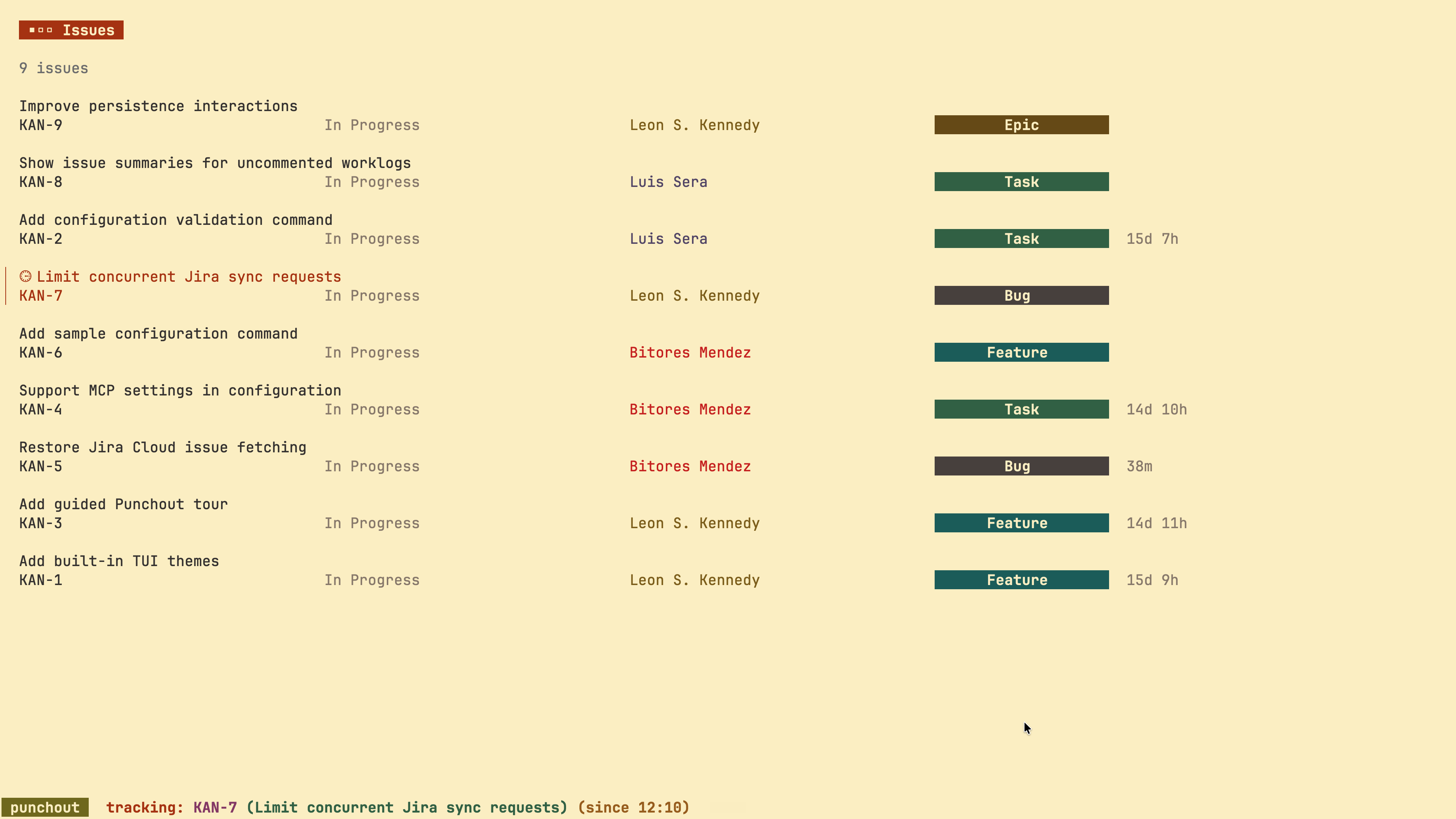 |
🔌 MCP Server
punchout comes with an MCP server which allows you to automate the process of
recording worklogs and syncing them to your JIRA server.
The server uses stdio by default:
punchout mcp serve
It can also use Streamable HTTP:
punchout mcp serve --transport http --http-port 18899
The HTTP server listens on 127.0.0.1, exposes the MCP endpoint at /v1, and
provides a health check at /health. Transport and port can also be set in the
[mcp] section of the configuration file.
The server provides five tools:
| Tool | What it does |
|---|---|
get_jira_issues | Return JIRA issues matching the configured JQL |
add_worklog | Record a worklog for an issue in punchout’s database |
add_multiple_worklogs | Record multiple worklogs in punchout’s database |
get_unsynced_worklogs | Get unsynced worklogs from punchout’s database |
sync_worklogs_to_jira | Sync all unsynced worklogs to JIRA |
Here’s one way the MCP server can be used:
🔐 Verifying release artifacts
Each release includes checksums for all artifacts. The checksum file is signed
using cosign (version
3.1.3).
Replace x.y.z below with the release version you want to verify.
Get the checksum and cosign signature from the release:
curl -sSLO https://github.com/dhth/punchout/releases/download/vx.y.z/punchout_x.y.z_checksums.txt
curl -sSLO https://github.com/dhth/punchout/releases/download/vx.y.z/punchout_x.y.z_checksums.txt.sigstore.json
Verify the checksum file’s signature:
cosign verify-blob \
    --bundle punchout_x.y.z_checksums.txt.sigstore.json \
    --certificate-identity-regexp 'https://github\.com/dhth/punchout/\.github/workflows/.+' \
    --certificate-oidc-issuer "https://token.actions.githubusercontent.com" \
    punchout_x.y.z_checksums.txt
Download the archive for your platform and validate its checksum. For example, for Linux x86-64:
curl -sSLO https://github.com/dhth/punchout/releases/download/vx.y.z/punchout_x.y.z_linux_amd64.tar.gz
sha256sum --ignore-missing -c punchout_x.y.z_checksums.txt
Once both checks pass, extract the archive:
tar -xzf punchout_x.y.z_linux_amd64.tar.gz
./punchout -h
Changelog
The format is based on Keep a Changelog, and this project adheres to Semantic Versioning.
v1.5.0 - Sep 05, 2026
Added
- Built-in themes
- Support loading cached JIRA issues when starting the TUI
- Support configuring database path, TUI settings, and MCP settings in config file
- A guided introduction to punchout’s main features, available via
punchout tour - Command to validate configuration (
punchout config validate) - Command to show sample configuration (
punchout config show-sample) - Support for MCP protocol version
2026-07-28
Changed
- Change default TUI theme to
gruvbox-dark-hard - Limit concurrent JIRA requests when syncing worklogs
- Worklog lists now show issue summaries for entries without comments
- Show days in worklog durations
- Expand environment variables in all string configuration attributes
- Redact JIRA tokens in
--list-configoutput
Removed
- Publishing new releases via Homebrew
Fixed
- Show the correct begin timestamp for an active worklog after restarting punchout
v1.4.0 - Mar 17, 2026
Fixed
- Fetching issues from cloud installations (which broke due to deprecation of the underlying JIRA API)
v1.3.0 - Dec 24, 2025
Added
- An MCP server that allows for creating worklogs and syncing them to JIRA
- Allow syncing worklog timestamps with each other in workflow create/edit form
- Show time duration being recorded in workflow create/edit form
- Allow quickly finishing a worklog (ends worklog at current time, doesn’t ask for comment)
v1.2.0 - Jan 16, 2025
Added
- Allow for quickly switching actively tracked issue
- Add support for fallback comments
- Allow updating active worklog entry
- Add support for JIRA Cloud installation
- Allow shifting timestamps for worklog entries using h/j/k/l/J/K
- Show time spent on unsynced worklog entries
Changed
- Save UTC timestamps in the database
- Allow going back views instead of quitting directly
- Improved error handling
- Upgrade to go 1.23.4
- Dependency upgrades
v1.1.0 - Jul 2, 2024
Added
- Allow tweaking time when saving worklog
- Add first time help, “tracking started since” indicator
- Show indicator for currently tracked item
- Show unsynced count
- Add more colors for issue type
- Dependency upgrades